Deep Work
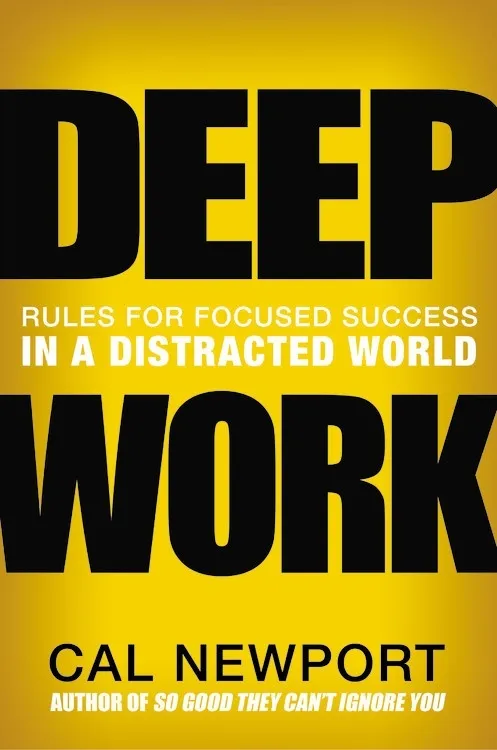
Deep Work by Cal Newport (Goodreads).
This book is part of the books to read in your 20s list shared by my friend Yash.
Deep Work is a self-help book that talks about how to stay focused without getting distracted. I agree, this one-line description is quite vague. Since the book is nonfiction, I will try to summarize the book first and then review it.
This was supposed to be a harsh critical review of the book but as time flew, I forgot many arguments against it and decided to write a balanced review looking at both the positive and negative aspects.
This should go without saying, but apologies if my summary is inadequate or inaccurate. I have tried to paraphrase from the book as much as possible, but due to communication barrier and other uncertainties, I might have misunderstood some concepts.
Summary
The book is divided into two parts. Part 1 is about the idea of deep work. It explains what is deep work and tries to convince you why you should deep work. Part 2 is about the rules that you should follow to do deep work.
In the Introduction chapter, the author defines deep work as follows.
Deep Work: Professional activities performed in a state of distraction-free concentration that push your cognitive capabilities to their limit. These efforts create new value, improve your skill, and are hard to replicate.
Examples of deep work are working on a research paper, planning next moves of a product and other rewarding works.
The opposite of deep work is shallow work, which is defined as follows.
Shallow Work: Noncognitively demanding, logistical-style tasks, often performed while distracted. These efforts tend to not create much new value in the world and are easy to replicate.
Examples of shallow work are checking email, tweeting and posting in social media.
The chapter then continues with a few examples of people who abandoned their shallow work and adopted deep work and attained success. Using these examples, the author proposes The Deep Work Hypothesis as follows.
The Deep Work Hypothesis: The ability to perform deep work is becoming increasingly rare at exactly the same time it is becoming increasingly valuable in our economy. As a consequence, the few who cultivate this skill, and then make it the core of their working life, will thrive.
Part 1: The Idea
Deep Work Is Valuable
The idea here is that as technology improves, companies are more likely to hire machines than humans. To avoid being replaced by an automation, the author says a person must belong to one of the three groups described below. That is, people belonging to these groups are unlikely to be replaced by machines in the near-future.
- The high-skilled workers
These are the people who can understand and work with complex machines. As technology gets complex, these people are employed to produce value from the machines.
- The superstars
As communication and network improves, companies are more likely to hire remote workers far away from the company’s location who can perform the work in the best and cheapest manner. They are high skilled professionals who can be hired on requirement instead of hiring an okayish full-time employee.
- The owners
These are the rich people. Or more precisely, the people with capital who can invest in new technologies and experiments.
How to thrive in this new economy where most probably only the above people are going to survive? The author suggests two abilities.
- The ability to quickly master hard things.
- The ability to produce at an elite level, in terms of both quality and speed.
To attain these two abilities, you need deep work.
The author does mention that there are people who do not deep work, like Jack Dorsey (founder of Twitter). He says that people like Dorsey are an exception, because as a CEO, he is required to focus on multiple things at the same time and to ask him to stick to one task for hours is not valuable.
He then says that such exceptions are quite rare and that unless you have a strong evidence that a distraction-full work is must for your success, you would do better with deep work.
Deep Work Is Rare
The author talks about three trends in today’s world, which he believes to hinder productivity than produce more.
- Open office culture where everyone can look at what others are doing and learn new things.
- Instant messengers which allows us to quickly send and receive messages.
- Expecting social media presence for the success of an individual.
The author suggests that the above claims are believed because of the metric black hole where it is difficult to measure the impact of one in a knowledge work (where the output is not directly measurable, like say a factory worker producing x units of a product in time y is measurable, but for a manager, it may not possible to estimate whether their presence is useful or not).
To disprove the biases, the author talks about two principles.
- The principle of least resistance
A business setting, without clear feedback on the impact of various behaviors to the bottom line, we will tend toward behaviors that are easiest in the moment. So for example, it is considered easier to just reply instantly than let the email wait.
- Busyness as proxy for productivity
In the absence of clear indicators of what it means to be productive and valuable in their jobs, many knowledge workers turn back toward an industrial indicator of productivity: doing lots of stuff in a visible manner. As an example, by attending a lot of meetings without breaks, people think you are productive.
- The cult of Internet
People think social media presence is must for their work to reach success. For example, a news firm might push their journalist towards posting in social media regularly, even though the journalist is more productive without doing it.
Finally, the author concludes by saying that such practices are bad for business in the long run. But only few know it. So it is good news for a deep worker, because as their colleagues and employers are stuck in this myopia, they can deep work to stay ahead of the mob in the upcoming economical change.
Deep Work Is Meaningful
This chapter talks about why you would like deep work.
- A neurological argument for depth
The world is the outcome of what you pay attention to, so if you train your brain towards positive aspects, then you would have a more pleasant mood.
- A psychological argument for depth
Structured activities with built-in goals, feedback rules and challenges encourage an individual to concentrate and accomplish it. On the other hand, an unstructured activity like free time requires effort to be shaped into something that can be enjoyed.
- A philosophical argument for depth
I can not understand what the author tries to convey here. I think it is more like, when you work on something with craftsmanship and meaning, you will enjoy the work more than get bored.
All of the above arguments are backed with insights from research and philosophers.
Part 2: The Rules
Work Deeply
Work without getting distracted. No seriously, that’s the summary of this chapter. The chapter is full of anecdotes from successful people on why they hate distraction and how they deep work. This ranges from avoiding emails, having strict schedule etc.
You can deep work by making it a ritual, where once entered, you strive to finish it no matter what. Or you make an expensive investment that reminds you to stay focused.
There are a lot of anecdotes in this chapter which discuss the person’s deep work strategy. I find it difficult to summarize without narrating the anecdote itself. But the ultimate rule is, work deeply.
Embrace Boredom
With time and patience, you can achieve any skill. All you need is a proper schedule. Focus on your work rigorously and take breaks as required. By confining distraction to well defined time slots, you avoid losing focus.
Quit Social Media
Quit social media unless you are sure it adds value to your life. If it does, then allocate a time slot to it and try to reduce it eventually. Do not let your leisure time be wasted by feeding on social media.
Drain the Shallows
Have a schedule where you plan your targets and activities for a day and abide by it. Keep it flexible in such a way that when an important work comes, you can provide time for it from a less important work. Do not over work. Show your boss how much shallowness is there in your daily work. This would convince your boss to remove yourself from shallow work of replying to emails instantly and give you more place for deep work.
Whatever shallow work you do, try to do it in a way such that you do not add more work in name of doing the shallow work. For example, in email, it is fine to not reply to vague emails from unimportant people as long as it would not impact your work. When replying to an email, precisely list out everything, even answers to most probable follow-ups. For example, if someone asks you if you are free for a coffee, reply with dates and time when you will be free.
Conclusion
The world is more distracted and people are biased that the distraction is useful. However, the author says that we should step out of this obligation and be the best of what we can be.
This may not be the best summary of the book. The rules chapter offer a lot of informative pieces that is difficult to repeat without making this page unnecessarily lengthy. I might have also missed some essential points or perhaps misunderstood what the author says. So for a deep summary of Deep Work, please check your favorite Youtuber or blogger.
Now let me review the book.
The good part
The book has a lot of anecdotes. It was interesting to read them and understand how it worked for them. For example, I did not know about Basecamp’s 4 day work week.
The importance of a structured work was discussed nicely in the book. It is always easy to work with a well-defined task properly divided and tagged than a vague open-end job.
Having a strict live-schedule (where you make adjustments as they come) is a rewarding skill. I think the more we remove ambiguity from our daily activities, the more we feel productive (as you no longer have to anticipate what’s next).
The amount of distraction in today’s world and how it damages any form of work is also highlighted in the book.
Finally the effect of social media and the addiction it brings is also analyzed well in the book. As technology improves, social medias are only getting more addictive. Starting from text-only interface to now short videos and AR/VR based networks in the future. Though social media is fun and highly productive when used properly, I do not think majority of us consume it that way. As countries are trying to ban social media for children, I think we should start to find out what purpose the social media serves for us and try to tame it than it tames us.
The okay but part
This section is not necessarily meant to pan the book, but simply highlight certain arguments I do not feel convinced.
The book is very much opinionated and biased towards a certain group of people whose job and positions can afford the deep work. Not all of us can afford the environment where such deep work is possible. For example, the book talks about an isolated room with no distractions. It is not possible for an average company to provide each employee with such facility, let alone convince them to do so. For majority of us, we must learn to work with where we are, than dictate what we want.
The ability to stay off emails and reply selectively is also a privilege. A boss can always reschedule their meetings, ask their PA to weed out vague emails and afford to go to a natural wonder in other side of the world to analyze the next moves. But for a junior who has to survive through whatever happens, if not get replaced by millions of people seeking jobs, it is not possible.
The purpose of social media has been greatly undervalued. I have a friend who recently launched an app as a solo developer. Now he can not get users for this app without paying hefty money for ads and promotions. If he had a plausible social media presence with followers and connections, his life would have been much simpler. Same goes for many of us. Not everyone is lucky to have a sleeper hit where the products is promoted by word-of-mouth.
(Not a promotion, but if you are curious, it is an app for generating travel itinerary with AI. You can download it from Apple App Store or Google Play Store).
I agree that social media presence for the big sharks can be unproductive. For example, asking an author to constantly tweet about the book and participate in discussions can be annoying. But it is all about the positions. For such an author, their work speaks for themselves. For a newbie, they have to spend their own time and efforts to spread the word.
Speaking of which, the very definition of what constitutes a deep work and what not is archaic. The distraction in your work can be part of my work. For example, think of a sales agent. Their work would be to answer customer queries, quickly address grievances. To ask them to go offline and stay inside a closed room for hours is not useful for neither the company or the person.
Social media is also not an easy shallow work. Imagine if you are a social media analyst whose daily job is to go through different people’s posts and understand the state of market. Your job would be super distracting as you navigate through multiple websites and read the never-ending posts. But that’s your job and it is definitely not easy.
Some other reviewers also suggested the gender stereotype in the book. The author is a male working in a prestigious institute. Expectations from his household and work may not be as same as a single mother who would have to take care of household chores and at the same time survive the office politics and inequality in a less popular college.
A few also talked about how the book is full of author’s personal stories which he uses a proof that it must work for everyone. Some feel that the book is an irony such that it repeats the same points throughout the chapters instead of saving the reader’s time by making it a properly structured blog post.
An interesting dilemma I and few other reviewers also found is, what is the point?. By all this deep work where you follow a strict schedule, make yourself unreachable, avoid social media entertainment and other forms of ideologies, what is the ultimate goal? You could have a peaceful life with a good network of friends and family where they value you for the person and not for your so called success in academia or job.
Conclusively, if you ask me, I would say to focus on both material and immaterial goals. Have a well defined goal. It can be a career change or research paper. Do what is needed of it to make it possible. If it needs answering hundreds of phone calls, do it. If it needs being active in social media, go for it. If it needs waking up at 3 AM and working alone, follow it. Ultimately, you should decide what is the deep work and distraction for you. Ignore all the segregation in the book of what is good and what is bad. But follow the methodology. Once you know your goal and what prevents you from doing it, make a schedule that reduces the preventive factors. This way, we all can achieve what we want without copy-pasting strategies of others.